Intelligent Vaccine Test Tube Loading & Unloading Solution: Safeguarding Biosample Security with Submillimeter Precision
Overview
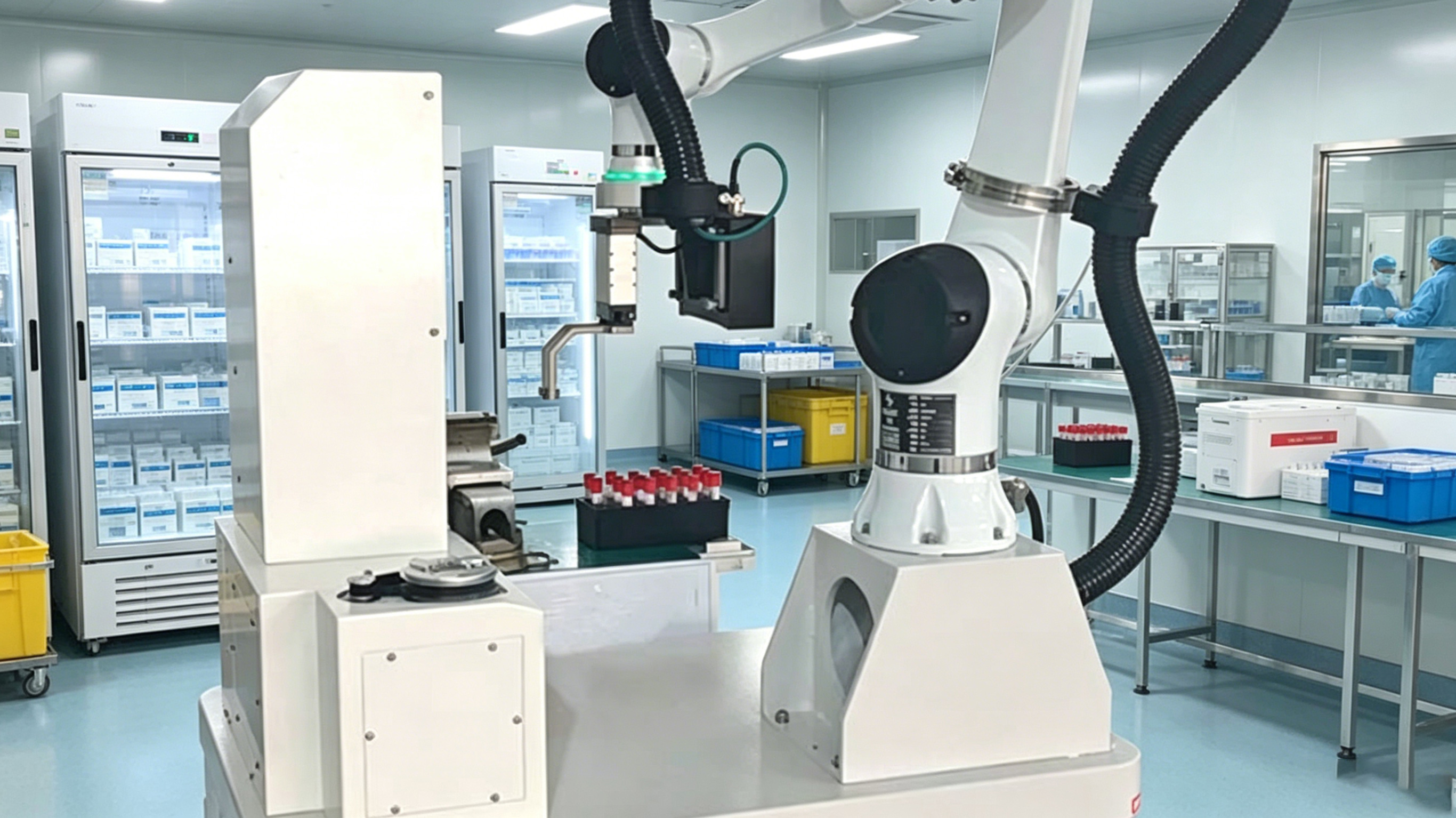
In biomedical laboratories, sample contamination and operational errors carry irreversible consequences. ForwardX Intelligent delivers an integrated composite robot solution built on deep fusion of AMR, collaborative robotic arms, 3D vision and force control technologies. It provides a closed-loop capability of zero contact, zero error and round-the-clock operation for automatic loading/unloading, transfer and dispensing of vaccine, reagent and other biological sample tubes. Covering the full workflow from sample retrieval in labs to on-site detection, every test tube is kept under controlled status, fully meeting stringent requirements for biosafety, precise operation and compliant traceability.

Challenge 1: Biosafety Risks — Every Contact Point Is a Potential Hazard
Under traditional manual operation, throughout the full workflow of retrieving vaccine tubes from refrigerators, aliquoting, testing and returning to storage, direct contact between operators and samples creates dual risks. Samples may become contaminated by human contact, while operators may be exposed to potential pathogens. Especially inside biosafety cabinets, any non-standard movement may disrupt airflow balance and cause contamination spread.
Challenge 2: Precision Bottleneck — Physical Limits of Human Eyes and Hands
On a 96-well plate, each well has a diameter of merely 8 mm with only 9 mm spacing between adjacent wells. Prolonged high-concentration manual work easily triggers fatigue, leading to misplaced tubes, cracked test tubes and worn labels, which invalidates samples or breaks traceability. Furthermore, accurately identifying and picking a designated tube among densely packed tube racks is nearly impossible for human operators.
Challenge 3: Dual Pressures of Cost and Efficiency
Sample processing for vaccines and reagents involves massive repetitive, high-precision delicate operations requiring highly skilled personnel with weeks-long training cycles. Sample volume fluctuates dramatically with peak backlogs and idle staff during off-peak periods. Traditional shift scheduling cannot respond flexibly, and manual speed fundamentally limits lab throughput.
Challenge 4: Insufficient Flexibility — Rigid Responses to Scenario Changes
Different experimental workflows require test tubes of varied specifications (1.5 mL, 2 mL, 5 mL, 10 mL), different well plates (96-well, 384-well) and diverse carriers. More complex tasks involve frequent access to biosafety cabinets, refrigerators, centrifuges, barcode readers and dispensing instruments. Traditional fixed automation incurs high renovation costs and long lead times when facing such changes and lacks elasticity.
Challenge 5: Preprocessing Technology — The “Technical Summit” of Test Tube Capping/Decapping
Decapping and recapping of test tubes constitute one of the most critical preprocessing steps. Test tubes from different brands adopt screw caps, rubber stoppers, push caps and other sealing types, each demanding distinct torque, pulling force and angles. Traditional grippers either slip due to unstable clamping or damage tubes and spill contents from excessive force. Automating this step has long been an industry technical bottleneck.

Core 1: High-precision 3D Vision Guidance & Dynamic Compensation — Solving Precision Issues for Reliable Identification and Stable Gripping
Pain point link: Densely arranged test tubes (e.g. 96-well plates) with well spacing at millimeter scale; positional deviations are unavoidable after manual handling or AMR relocation.Solution: Integrate high-resolution 3D cameras and deep learning vision algorithms to realize submillimeter-level recognition and positioning of test tubes, plate wells and carriers. Critically, the system features dynamic gripping compensation. Even when millimeter-level positioning errors exist after AMR arrives at the workstation, the vision system can correct coordinates right before robotic arm execution to guarantee accurate picking every single time.Value output: Positioning accuracy reaches ±0.5 mm, gripping success rate >99.9%. Tube damage and misplacement are completely eliminated.
Core 2: Integrated Intelligent Composite Robot — Solving Efficiency Problems of Mobile and Fast Transfer
Pain point link: Samples need circulation across multiple workstations including refrigerators, preprocessing stations and testing instruments. Traditional manual transport suffers low efficiency and safety hazards.Solution: AMR acts as a mobile base paired with collaborative robots to realize a closed-loop workflow: retrieving samples from refrigerators, transporting to operating stations and delivering to testing instruments. Adopting laser SLAM navigation, the AMR autonomously plans paths and dynamically avoids obstacles in complex lab environments, with no magnetic strips or QR codes required.Value output: A single unit completes end-to-end circulation among multiple stations, boosting transfer efficiency by 300% and cutting labor costs by over 60%.
Core 3: Special End Effector & Intelligent Gripper — Solving Adaptability for High Success Rate and Zero Damage Gripping
Pain point link: Wide variety of test tubes (1.5mL~10mL), including glass and plastic materials. “Damage-free gripping” is required for different tube diameters and materials, which traditional clamps struggle to achieve.Solution: Adaptive gripper automatically adjusts clamping force based on tube diameter and uses compliant contact surfaces for non-destructive, stable gripping for tubes of varied specifications. The end effector also integrates rotation function to spin test tubes after gripping for barcode scanning, completing “one-time gripping and synchronous verification”.Value output: Compatible with 95% of common test tube specifications; clamping force precisely adjustable, zero tube breakage rate.
Core 4: ForwardX Self-developed Decapping Technology — Breaking the “Technical Summit” of Test Tube Preprocessing
Pain point link: Tube decapping is the most complex and error-prone preprocessing step. Different sealing forms (screw caps, rubber stoppers, push caps) impose vastly different requirements for force control and mechanical design.Solution: This highly differentiated proprietary technology integrates special mechanical design, high-precision position-force hybrid control and intelligent vision guidance. The end effector can stably hold tube bodies, and through adaptive mechanisms and precise force strategies, complete non-destructive, stable decapping and recapping for multiple tube specifications and sealing types. The system senses force changes during extraction in real time and dynamically adjusts motion parameters to ensure one-time success for both cap tightening and loosening.Value output: Decapping success rate >99.5%, compatible with three major categories: screw caps, rubber stoppers and push caps, fully enabling automatic closed-loop sample preprocessing.
Core 5: Unified Control & Safety Architecture — Solving Collaboration and Integration Issues
Pain point link: Coordinated scheduling of multiple devices (refrigerators, centrifuges, scanners, dispensers) together with AMR and robotic arms is complex. Traditional integration features long cycles and high maintenance costs.Solution: Integrated software control platform to uniformly schedule AMR navigation, robotic arm motion, vision processing and end tool operation. The platform natively supports TCP/IP, EtherCAT, Modbus and other standard industrial protocols, enabling seamless connection with Laboratory Automation Systems (LAS) and LIMS systems to unify information flow and physical flow.
The system is equipped with full-perimeter safety protection: AMR laser radar + 3D vision + safety edges realize dynamic obstacle avoidance; collaborative robot force feedback and collision stop guarantee safe human-machine interaction.Value output: Deployment cycle shortened to 3 days, plug-and-play system docking and greatly reduced operation & maintenance barriers.
Core Advantages & Value
Full-process Biosafety: Zero-contact automation eliminates personnel exposure and cross-contamination risks.
Breakthrough Operational Precision: Submillimeter positioning accuracy (±0.5 mm), gripping success rate >99.9%.
Efficiency Revolution: 7×24 continuous operation; one unit replaces 3–5 operators and increases processing throughput by 200%.
Flexible Deployment: Modular design, deployment finished within 3 days to rapidly adapt to diverse test tube specifications and workflows.
Full-chain Traceability: Automatic recording of timestamp, position and sample information for each operation to form complete digital archives.
